When it comes to the responsible breeding of dogs, there are some things that are frequently thrown out as immediate red flags for those in search of a puppy. It’s all because those who are searching for puppies want to do the right thing. That’s good, that inclination. So people learn a prescriptive way to do said ‘right thing.’ But today’s world is a bullet point landscape in a portrait of nuance.
With breeding dogs, there’s lots of those ‘red flag’ bullet points. All aimed, precisely against certain practices. Some of those bullets are well aimed. For instance:
- Health testing of dogs used for breeding
- Using females who are of appropriate age, not too young, not too old, etc.
- Giving puppies appropriate access to everything they need to be healthy and stable
But the list of things that get included in that ‘red flag’ territory (including me, from time to time) is much longer. One of those things is to be wary of breeders who have both the male and female on the premises. On its face, this is solid advice. I’ve given it myself many times over the years. If we want the best match for our girls, it usually isn’t the most conveniently located male to her. The odds just aren’t in favor of that.
And yet.
Does that mean that if a breeder uses her male with her female that it should be an automatic red flag, or perhaps should we start to institute a yellow flag system which signals to pause and ask some educated questions. Then, make the determination of which way the play should be called. Foul or good.
I bring this up because breeding dogs always throws us curveballs. (Side note: Dang, I just can’t stop with the sports analogies, can I? Super funny that as I write this it’s mid March and in some random recent conversation two guys were talking about ‘the game’ and I had to ask… is the game basketball? That is my level of sportsing. Anyway…)
Our curveball arrived on a random Friday night in June of 2025. Nick and I were getting ready to visit our favorite local happy hour and a text came through to me from a Leo friend, Kim. “Do you or Nick have time for a quick call?”
Immediately a sense of prickly prescience kicked in, and I knew this was about one of our friends, and it involved a Leo. And it probably had nothing to do with a winning lotto ticket.
It was not good news. Linda, a friend we’d known for many years, and who had owned the sire we used for our fourth litter, who took a puppy from that litter, was in the hospital. It was unclear if she would come home. She’d been hospitalized for weeks already. She had two imported Leo males, one of whom had just passed away, leaving just the younger dog all alone in the house, being cared for by a woman who was extremely pregnant with high risk and due July 1st. She was visiting a few times a day to care for him, but worse, the dog, Izzie, had grown despondent and was not eating. Who could blame the poor guy? His whole family was gone.
Linda, our hospitalized friend, had not had a kind few years. Her husband, Jeff, had died the previous summer. Her health had been deteriorating for several years and her dogs, though she loved them deeply, had spent most of their last few years in the house with her, with very little exposure to the outside world. It was heartbreaking all around because Linda loved nothing more in this world than her dogs. Anyone who had met her for more than a minute knew that to be true.
So, when we spoke with Kim about the situation, the intent was to mobilize some help for this dog, Izzie. Nick and I spoke about it privately, but it took us very little time to decide that the very next day Nick would drive to Rockford, Illinois from suburban Detroit and collect Izzie. We would care for him as long as Linda needed.
We had no idea what we would find with Izzie. He’d pretty much been cloistered. Yes, he lived with one other intact male. Linda had described him when we’d talked years prior as her ‘wild child.’ Who knew how that had progressed, now that Izzie was five years old and been through trauma of losing his entire family? Whatever we found, we also knew there were few people better equipped to handle this boy than Nick and I, with our training and breeding background.
Thankfully, when Izzie arrived on Sunday, he was fine with our two girls, Lyric and her daughter, Letty. But his mane, that beautiful Leo mane, was sopping wet with drool. In the coming weeks, we’d learn that the mane wet with drool was simply what happened when he was intensely anxious.
Izzie was not aggressive (thankfully!) in any way. But he was skittish in our new environment. The girls gave him space. Letty was only about a year old, and she was curious about him, wanting to make a new friend. Lyric was pretty ambivalent, which suited everyone just fine. She seemed to take the same tack I was planning on. Just let the guy have some space, get used to us, our schedule, our house and environment. Earn his trust slowly, one interaction at a time.
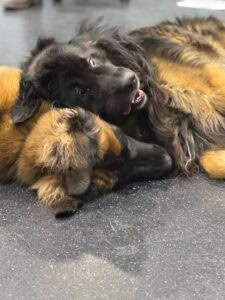
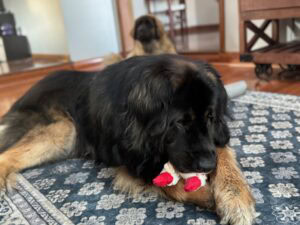
Still, for those first few days, if Nick or I moved too quickly, Izzie would jump up and back away. Letty faired better with him. I have pictures from only a couple days in with Letty and Izzie sleeping inches away from each other. It remains so to this day, though now, usually Izzie has one paw touching Letty’s paw.
Over the coming weeks, we started to see his personality. Bit by bit, he came out of his shell. Friends would come over and remark how much more social he was getting.
During these first weeks, we were in as much touch with Linda as we could be. Her condition was not improving, and it was fairly clear even if she could return home, she was in no condition to take Izzie back. With her blessing, we made arrangements that if the worst happened, Izzie would stay with us. He had quickly worked his way into our hearts. If Izzie couldn’t be with Linda, there was nowhere else he should be other than with us.
And sadly, in the middle of July, we learned that Linda had passed away.
Months more passed and Izzie continued to amaze us. His true personality was shining through. This was a dog who had been through so much, but he was returning to the stable, calm representation of the best Leonbergers.
By September, we had hosted a euchre party (if you don’t know what that is, you clearly aren’t a mid-westerner). Suffice it to say, we had a dozen people over the house and Izzie was… fine. He acted like any other Leo I’d had over the years. Maybe a bit reserved, but not upset, not drooling, not avoiding. Given his history and his age, his progress was astonishing.
Around this time, I was also beginning to plan Lyric’s second litter.
One of the first things to be decided when planning a litter is ‘who is daddy going to be?’ The sire of the litter provides half the genetics, so it’s pretty dang important. It also requires some legwork. Evaluating pedigrees. Figuring out what type of insemination you’re planning (frozen, chilled, TCI, natural), what lines you want. Making a good structural (conformational) match. The temperament of the sire. How many litters has he already had?
As I am refining my philosophy as a breeder, contributing to the genetic diversity of our breed is becoming more and more important to me. This question isn’t about the next generation, or even the next few generations. This is about preservation of the breed for perpetuity. Leonbergers, like any purebred, are, by definition, a closed gene pool. That comes with problems. Without diving too deeply into genetics, closer relations means the likelihood of undesirable recessive traits surfacing increase. So making sure we aren’t speeding up that process by only using a handful of popular sires is critical.
So, as I’m researching pedigrees for the sire of Lyric’s next litter, I keep coming across a few dogs who are in Lyric’s pedigree and pretty much anyone else who ticks all the boxes I’m looking for. The potential sires I liked were too closely related to her for my comfort. I looked at pedigrees for hours over several sessions before getting discouraged. And anyway, I had months to decide. So I put a pin in it for the moment. Using Izzie was nowhere on my radar.
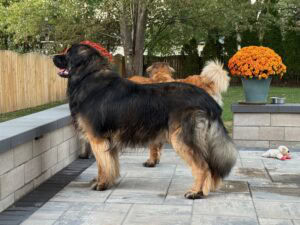
Meanwhile, Izzie continued to thrive. I had a few moments of considering if I would test him to become a therapy dog. I ultimately decided not to, but that gives you an idea how profound the change in this dog was. He took to training and after lots of practice, he graduated to off leash romps in the woods with the girls (on a GPS collar, for good measure!) He would now go up to people and offer his behind for petting. He was, with only one exception, utterly dog neutral. At our most recent raucous euchre party, Izzie plopped himself down in the most inconvenient spot in the house, right in the middle of the foot traffic of nearly two dozen people. He cared not a lick if anyone stepped over him or stooped down to pet him. He could also be found sidling up to some of his more preferred people for ear rubs and petting.
What a picture perfect representation of the thing we forget about purebred dogs. We are trying to influence the ‘nature’ side of the ‘nature versus nurture’ equation. We are trying to create a form, a function, a temperament when we choose to breed these dogs. Leonbergers were not bred for a function, one of the few breeds that can make that claim. They were bred for a form and a temperament. So, right up there with health, temperament has always been my top priority. Izzie’s genetics, his nature, despite terribly difficult circumstances, were showing through, and what a beautiful thing it was to witness.
Linda had imported many males over her time in our breed. Izzie was from Poland. One day, just for kicks, I looked up his pedigree. I was kind of shocked to see Izzie had exactly the kind of genetic diversity I was looking to match with Lyric. But I didn’t know much about his lines. I reached out to his breeder, seeking information, and people in the states who might know more than I did.
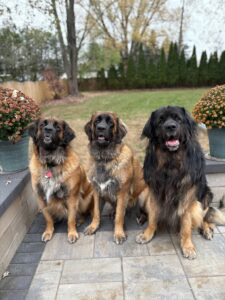
The more I learned, the more I started to entertain the idea. Was Izzie a possible match for Lyric? Part of me rebelled against it subconsciously because I was one of those people who had looked sideways at breeders who had both the male and the female. We had never had both in our house. It was almost a badge of pride that we had to go to extra lengths to find just the right boy.
But Izzie was now five and half years old. He had only had his clear by parentage genetic testing and dentition checked and submitted to OFA. No other health testing done. What were the odds that he would be able to pass OFA hips and elbows at his age? That his thyroid and eyes would still be normal? More than that, giant breed dogs are known to age faster, so what did that mean for his sperm count? The odds of him being a candidate for breeding to Lyric on a strictly health level seemed astronomically stacked against us.
Still, I started to do the testing, promising myself I’d stop when the inevitable unfavorable result came in. It never did. Sperm count: Great. OFA hips: Good. Elbows: Normal. Thyroid: Normal. Eyes: Normal. He was closer to six now as the months passed and these results continued to filter in. I was amazed. Moreover, Izzie’s general health had been fine. Linda had very few vet records, other than vaccinations, to give to us simply because there had not been any. Izzie was a healthy guy.
Now I had a male in my home who was not used by anyone else, had great health at middle age, supported genetic diversity in our breed, and structurally complemented Lyric. It was serendipity at its finest.
Breeding dogs well and ethically is a complicated, multi-layered affair. Perhaps, if you see something that looks like a red flag when searching for your next breeder, squint a bit closer to see the true shade. It might indeed be red. It might be a weird shade of chartreuse. It might just lead you to your perfect match. But you won’t know unless you ask the questions.
Would I let my preconceived notions of what it might look like to others to use this boy deter me? I decided I would not.
Lyric x Izzie puppies are expected May 6th, 2026.